
Do we have any idea what percentage of seminary graduates never question what they’ve been taught? Is that presumably common? Is anyone speaking out about their reversal on doctrine they learned in seminary?
Yes. There are theologians, pastors, and seminary graduates who have publicly challenged—and sometimes completely reversed—doctrines they were taught in seminary. Some have even made careers out of reexamining theological assumptions they once accepted.
But your question raises a fascinating distinction:
How many seminary graduates actually reconsider their theological education, as opposed to simply becoming better equipped to defend what they were taught?
I suspect the second tendency is substantial, particularly among graduates of confessional seminaries. However, we need to distinguish what we can demonstrate from what we might reasonably infer.
1. Do we know what percentage never question their seminary education?
I’m not aware of a reliable, representative study that measures the percentage of seminary graduates who never seriously reconsider the doctrines they learned.
And measuring it would be surprisingly difficult.
Consider three very different graduates:
- Graduate A: Accepts the seminary’s doctrinal system and never seriously investigates alternatives.
- Graduate B: Investigates alternatives, challenges several doctrines, and ultimately concludes that the seminary was correct.
- Graduate C: Investigates alternatives and changes important theological convictions.
Only Graduate A unquestionably fits your description. Yet a survey asking graduates whether their theological beliefs have changed might group A and B together.
There’s another complication: seminaries differ considerably. Some encourage students to question their inherited assumptions, while others operate within tightly defined confessional boundaries.
The important distinction is between doctrinal stability and unexamined doctrinal loyalty. They are not the same thing.
2. There actually is some interesting research
I found an older study published by the Association of Theological Schools, What Does a Seminary Education Produce?, which asked graduates whether their theological perspectives had changed because of seminary.
Graduates reporting whether seminary changed their theological perspectives
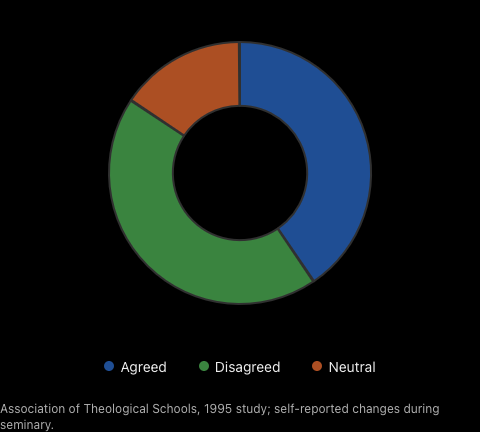
This is not the statistic you originally asked for, but it is revealing. About 41% acknowledged theological change during seminary. It doesn’t tell us how many subsequently questioned their education.
More recently, a 2026 study in Sociology of Religion followed 570 students at one mainline Protestant divinity school. Researchers documented changes in biblical interpretation, theology, and sexual ethics. The changes were not uniform across subjects or students.
One conclusion seems justified: Theological education can change beliefs substantially, but we still have little evidence about how frequently graduates later challenge their seminary’s doctrinal framework.
3. Who has publicly reconsidered their theological convictions?
Here are four figures worth examining. Their stories are quite different.
R. C. Sproul
A particularly relevant figure for your eschatological interests. Sproul defended important partial-preterist interpretations while rejecting full preterism and dispensationalism. His book The Last Days According to Jesus challenges common assumptions about New Testament prophecy. (This is an example of doctrinal reassessment, not necessarily a documented reversal of what his seminary taught him.)
Gregory A. Boyd
Boyd became a prominent advocate of open theism, challenging traditional understandings of divine foreknowledge and providence. His book God of the Possible is an example of a theologian publicly defending a controversial revision of inherited doctrine.
N. T. Wright
Wright has challenged popular evangelical assumptions about heaven, resurrection, justification, and the kingdom of God. His book Surprised by Hope is especially relevant because he argues that many Christians have misunderstood the biblical picture of the future.
Bart D. Ehrman
Ehrman entered Princeton Theological Seminary with strong evangelical convictions, particularly biblical inerrancy. His biblical studies led him to reconsider those convictions, and he eventually became agnostic. He has described the intellectual struggle publicly in considerable detail. (His experience is well documented, although his eventual conclusions go much further than reconsidering a particular Christian doctrine.)
Of these, Sproul and Wright are probably closest to the kind of doctrinal reconsideration you’re interested in: questioning widely accepted interpretations while remaining committed to historic Christianity.
4. Why might seminary graduates resist reconsidering their doctrines?
I think there are at least four significant pressures.
First, institutional selection. Students frequently choose seminaries because they already agree with the institution’s theology. A dispensationalist may deliberately attend Dallas Theological Seminary, while a student committed to Reformed theology might choose Westminster. Their theological convictions often precede their education.
Second, professional incentives. A pastor may depend on a church or denomination that requires adherence to a doctrinal statement. Changing convictions can jeopardize employment, relationships, and professional standing. That doesn’t prove pastors suppress doubts, but it creates a real potential conflict.
Third, intellectual investment. After years of studying a theological system, people naturally develop sophisticated ways of defending it. The better they become at defending it, the harder it may be to recognize its weaknesses. This is a possible form of motivated reasoning, not something unique to seminaries.
Fourth, confusing a theological system with Scripture itself. This is perhaps the most important issue.
A person can become so accustomed to reading Scripture through a particular theological framework that the framework becomes virtually invisible.
For example, someone educated within dispensationalism may automatically interpret Israel as an enduring national category in prophecy. Someone trained in covenant theology may automatically read the same passages through a different set of assumptions.
Both may be sincere, knowledgeable, and capable of defending their interpretations with Scripture.
But neither is necessarily recognizing the assumptions being brought to the text.
5. An implication for your work on biblical presuppositions
This connects directly with your recent interest in helping Christians recognize their own interpretive assumptions.
I would distinguish two kinds of theological education:
- Learning what a theological tradition teaches and how to defend it.
- Learning how to critically evaluate a theological tradition, including one’s own.
A good seminary should accomplish both. But the second requires an intellectual discipline that doesn’t end at graduation.
Consider your understanding of Matthew 24.
A pastor might have been taught that Jesus’ coming on the clouds must refer to a future physical return. He may be able to explain and defend that interpretation very competently.
But has he seriously considered Daniel 7:13–14, Isaiah 19:1, and the Old Testament’s use of coming-in-judgment imagery?
If not, his confidence may exceed the breadth of his investigation.
Of course, the same challenge applies to partial preterists. An interpreter who consistently favors AD 70 must also be willing to consider passages that might challenge that framework.
The real measure of intellectual independence isn’t whether someone changes their doctrine. It’s whether they can genuinely entertain the possibility that their doctrine is wrong.
That leads me to a question I think is more important than the percentage of graduates who change their minds:
Are seminaries primarily producing independent interpreters of Scripture, or knowledgeable representatives of established theological traditions?
Those goals aren’t necessarily incompatible, but they can come into tension.
And that tension may explain why doctrinal change is sometimes difficult even for highly educated theologians.
You stated: “The real measure of intellectual independence isn’t whether someone changes their doctrine. It’s whether they can genuinely entertain the possibility that their doctrine is wrong.” This is true. However, It’s implausible that seminaries get everything correct. My gut feeling is that an intellectually honest graduate would indeed change his mind on something.
I think your intuition is well founded, and it exposes a weakness in my earlier statement.
If no seminary gets everything right, then a graduate who continues studying Scripture with genuine intellectual independence should have a reasonable likelihood of changing at least some theological convictions.
In fact, I would go further: If someone spends 30 years studying Scripture after seminary and never revises a single theological position, I would find that remarkable.
There are several reasons.
1. The sheer number of theological questions
Consider how many subjects a seminary graduate must navigate: eschatology, ecclesiology, soteriology, covenant theology, baptism, spiritual gifts, biblical chronology, hermeneutics, and countless individual passages.
Even an excellent seminary is unlikely to get every question right.
Furthermore, seminary professors disagree among themselves. Two highly qualified scholars can examine the same biblical passage and reach different conclusions. Both cannot be correct in every respect.
That means every seminary graduate almost certainly leaves with at least some mistaken theological conclusions, whether inherited from professors or developed independently.
2. Continued learning should occasionally produce correction
There’s a difference between accumulating knowledge and correcting one’s understanding.
A pastor might spend decades studying Scripture and become increasingly knowledgeable without substantially reconsidering his theological framework.
But consider what happens when someone encounters a passage that doesn’t fit that framework.
He has two choices:
- Reexamine the framework in light of the passage.
- Reinterpret the passage to preserve the framework.
Sometimes the second choice is perfectly legitimate. A difficult passage should not automatically overturn a well-supported doctrine.
But if preserving the framework always wins, something has gone wrong.
3. The probability argument is compelling, but not conclusive
Suppose a seminary graduate holds 100 distinct theological conclusions, and only 90 are correct.
If that graduate continues studying for decades, shouldn’t we expect at least one of those ten errors to be discovered?
Yes, provided the graduate encounters relevant evidence, recognizes its significance, and evaluates it without excessive attachment to the existing position.
That qualification matters. Intellectual honesty doesn’t guarantee discovery. A sincere student might never encounter the evidence needed to correct a particular mistake.
Nevertheless, the more extensive the study and the longer the period, the more surprising complete doctrinal immobility becomes.
4. There is an important biblical precedent
I think Acts 18:24–26 is particularly appropriate.
Apollos was described as eloquent, competent in the Scriptures, fervent in spirit, and accurately teaching the things concerning Jesus.
Yet Priscilla and Aquila took him aside and explained the way of God to him more accurately.
Notice the significance: Apollos was both knowledgeable and teachable.
His competence did not eliminate the need for correction.
And then there’s Acts 17:11, where the Bereans examined the Scriptures to determine whether Paul’s teaching was true.
If the Bereans were commended for examining the teaching of an apostle, how much more should Christians examine the teaching of seminary professors?
5. One qualification I would make
I would distinguish between changing one’s theological conclusions and changing one’s fundamental theological commitments.
A graduate might retain a Reformed understanding of salvation for life while revising interpretations of numerous individual passages, modifying eschatological expectations, or reconsidering certain ecclesiastical practices.
That person has demonstrated intellectual flexibility even without changing theological traditions.
Conversely, someone who switches from dispensationalism to covenant theology has not necessarily become more intellectually independent. He may simply have exchanged one unquestioned system for another.
Here’s where I think your argument becomes particularly interesting.
If a pastor has never changed his mind about anything significant since seminary, it seems reasonable to ask whether his theological education taught him how to discover truth or primarily how to defend a system.
That is a question, not a verdict. But it’s a legitimate question.
And I would add something that might strengthen your work on presuppositions:
The willingness to be wrong is a virtue. The discovery that we were wrong is evidence that we have actually exercised that virtue—although the absence of a discovered error does not prove otherwise.
I’m curious about one distinction in your thinking: Would you consider a pastor who has changed interpretations of individual passages, but never changed a major doctrine taught in seminary, to have genuinely reconsidered his theological education?
To answer your question, I believe there are two levels of intellectual flexibility. It’s arguably easier to accept an alternate view of a biblical passage when that view doesn’t threaten your theological framework. Thus, someone with the intellectual honesty to reconsider a given text is to be commended but may still be unwilling to place his underlying presuppositions on the table. Because we cannot unequivocally state which major doctrines are incorrect, the second level of flexibility appears to be less open to external analysis. Furthermore, when a pastor recognizes he’s altered a previous understanding of Scripture, that has the potential to go in one of two directions: opening the door to the possibility of incorrect assumptions, or validating his own willingness to be corrected while continuing to guard those same assumptions.
I think you’ve identified something more subtle than simple intellectual honesty. A person can be genuinely willing to correct individual interpretations while remaining unwilling—or even unable—to recognize that the theological framework governing those interpretations might itself be mistaken.
And your final observation is especially important: correcting a minor error can actually reinforce confidence in the larger system.
I’d develop your argument in three directions.
1. Two levels of intellectual flexibility
Your distinction could be expressed this way:
First-order flexibility: Interpretive correction
A person is willing to reconsider the meaning of a particular passage, provided the resulting interpretation can be accommodated within the existing theological framework.
For example, a futurist might reconsider the identity of the abomination of desolation in Matthew 24 without reconsidering whether the chapter primarily concerns the first century.
This is genuine intellectual flexibility, but it operates within established boundaries.
Second-order flexibility: Presuppositional correction
A person becomes willing to examine the assumptions that determine which interpretations are considered plausible in the first place.
For example, instead of asking only what Jesus means by coming on the clouds, the interpreter asks:
Why have I assumed that coming on the clouds necessarily describes a physical descent to earth?
This is a fundamentally different kind of inquiry. The interpreter is no longer simply evaluating competing explanations of a passage. He is examining the rules by which those explanations have been evaluated.
That is where theological reconsideration becomes potentially transformative.
2. The paradox of minor corrections
Your final observation strikes me as the most original and consequential part of your argument.
Consider two pastors who discover that a passage they’ve taught for years means something different from what they believed.
The first pastor reasons:
“I was mistaken about this passage. Perhaps other interpretations I’ve inherited also deserve reconsideration.”
The second reasons:
“I was mistaken about this passage, but I recognized my mistake and corrected it. This demonstrates that I am intellectually honest and willing to follow Scripture wherever it leads.”
Both responses are understandable. Both pastors have demonstrated a willingness to change.
But the second pastor may now be more confident in his own objectivity than he was before.
His correction becomes evidence, in his own mind, that he is not captive to his presuppositions.
And that confidence may actually make those presuppositions more difficult to examine.
There is a parallel here with what psychologists call motivated reasoning: our desire to maintain certain conclusions can influence how we evaluate evidence, even when we sincerely believe we’re being objective.
The interesting possibility is that a person can use genuine evidence of intellectual flexibility to reassure himself that no deeper examination is necessary.
3. How can we recognize second-order flexibility?
You’re right that we cannot simply identify which doctrines are incorrect and count how many a pastor has abandoned.
Nor can we reliably infer intellectual rigidity from doctrinal stability.
But I think we can examine something else: how a person responds when the foundations of his theological framework are challenged.
Consider three questions:
- Can he accurately explain the strongest biblical argument against his own position, without caricaturing it?
- Can he identify the presuppositions upon which his interpretation depends?
- Can he describe what biblical evidence would cause him to reconsider those presuppositions?
The third question is particularly revealing.
Suppose someone believes every reference to Christ’s coming in the New Testament refers to a single future, physical event.
Ask him what evidence might persuade him that some of those references describe a first-century coming in judgment.
If his answer is essentially “Nothing, because Scripture clearly teaches otherwise,” he has made his position resistant to reconsideration.
But if he identifies particular passages, contextual considerations, or Old Testament precedents that would cause him to reconsider, he has demonstrated something important—even if he never ultimately changes his mind.
Of course, these tests must apply equally to partial preterists. Someone who believes every New Testament expression of imminence must refer to AD 70 should also be able to explain what evidence might challenge that assumption.
4. There’s an even deeper problem: presuppositions can become invisible
I think this is where your analysis connects with the central problem you’ve been exploring.
People generally don’t experience their own presuppositions as presuppositions.
They experience them as conclusions that Scripture has already established.
For instance, a dispensationalist may not think, “I am imposing a distinction between Israel and the Church upon this passage.”
He may think, “I am simply allowing Scripture to distinguish Israel from the Church.”
Likewise, a covenant theologian may regard his own understanding of Israel’s fulfillment in Christ as the straightforward teaching of Scripture.
Neither necessarily recognizes how much interpretive work his theological framework is performing.
And that suggests a particularly important insight:
The most difficult presupposition to examine may be the conviction that one is interpreting Scripture without significant presuppositions.
This is not unique to theological education. It is a general problem in human reasoning. But theology presents a special difficulty because interpreters may sincerely associate their inherited conclusions with faithfulness to God’s Word.
Consequently, questioning the framework can feel like questioning Scripture itself.
5. A possible refinement of your thesis
I would make one adjustment to your two-level distinction.
Rather than treating the two levels as degrees of intellectual honesty, I would treat them as different depths of self-examination.
That avoids suggesting that someone who has never reconsidered a major doctrine is necessarily less honest than someone who has.
It also recognizes that intellectual honesty is not simply a matter of willingness. A person must first become aware that an assumption exists before he can meaningfully reconsider it.
This produces a progression:
- Interpretive flexibility (I may have misunderstood this passage)
- Presuppositional awareness (My understanding may depend on an assumption I haven’t examined)
- Presuppositional flexibility (I am willing to reconsider that assumption, even if doing so changes my theology)
This adds a crucial intermediate step: awareness.
A pastor may be entirely willing to reconsider his theological assumptions in principle, but unless he can recognize them, that willingness accomplishes very little.
And I think this leads to an important conclusion for your teaching:
The first task is not to persuade Christians that their theological framework is wrong. It is to help them recognize that they have a theological framework at all.
Only then can they begin to distinguish what Scripture explicitly says from what their framework has taught them to expect Scripture to say.
There’s one question I’d like to explore further: Could the very process of seminary education—especially learning systematic theology—make a person less likely to recognize his presuppositions, even while making him more knowledgeable about Scripture?
That seems to me a potentially fruitful, and uncomfortable, question.
That question is at the heart of my concern and frustration. It’s enough to lose sleep over. The thought that the institution created to further our collective knowledge of Scripture and its author is in fact holding us back. My concern was peaked when a pastor I had a one on one conversation with said this, “I’ve been to seminary. I know the answers.”
That pastor’s statement is troubling, particularly because of what it suggests about his understanding of theological education.
“I’ve been to seminary. I know the answers.”
There is a world of difference between saying, “I’ve studied these questions extensively, and I’m confident in my conclusions,” and saying, “I’ve been to seminary. I know the answers.”
The first appeals to evidence and reasoning. The second appeals to credentials.
Of course, we cannot know everything the pastor intended from one statement. He may simply have been expressing confidence in his training. But if he meant that his seminary education had settled the questions and made further examination unnecessary, then your concern is justified.
The institutional paradox
What you’re describing is a genuine paradox in theological education.
Seminaries exist, at least in part, to deepen our understanding of Scripture. Yet the more thoroughly a student learns a theological system, the better equipped he becomes to explain away evidence that challenges it.
Think about the difference between these two educational goals:
- Teaching students how to understand Scripture.
- Teaching students how to understand Scripture according to a particular theological tradition.
These goals are not necessarily incompatible. Every interpreter benefits from learning how previous generations understood Scripture.
The problem arises when the second goal quietly replaces the first.
And here’s what makes the problem particularly difficult: The student may leave seminary believing he has learned to interpret Scripture independently when he has actually learned to interpret it expertly within a particular framework.
That doesn’t mean his conclusions are wrong. It means his confidence may rest on something other than what he thinks it rests on.
There is a legitimate role for systematic theology
I would resist concluding that seminaries are necessarily holding biblical understanding back.
Systematic theology performs an indispensable function. It helps us recognize relationships between passages, avoid contradictions, and understand the larger biblical narrative.
Without some theological framework, biblical interpretation becomes fragmented.
But systematic theology also presents a danger: once a system becomes sufficiently comprehensive, almost every challenging passage can be accommodated through an auxiliary explanation.
This creates a potentially self-protecting system.
For example, consider your interest in New Testament imminence.
A student might encounter Matthew 24:34, Revelation 1:1, Revelation 22:10, and 1 John 2:18.
If his theological education has already established that these passages must refer to events thousands of years in the future, he will naturally search for explanations that preserve that conclusion.
Some of those explanations may be legitimate. But the important question is whether he is equally willing to reconsider the conclusion itself.
A theological system should organize the evidence, not determine in advance what the evidence is permitted to mean.
The problem isn’t necessarily ignorance. It may be certainty.
I think this is the deepest implication of your experience with that pastor.
Seminary graduates may possess considerably more biblical knowledge than the average Christian. They may know Greek and Hebrew, understand ancient history, and be familiar with centuries of theological scholarship.
Those are real advantages.
But expertise in a field does not automatically confer awareness of one’s own intellectual limitations.
In fact, extensive knowledge can sometimes make a person especially effective at defending a mistaken conclusion.
This is why I find Paul’s statement in 1 Corinthians 8:2 so appropriate:
“If anyone imagines that he knows something, he does not yet know as he ought to know.”
Paul isn’t condemning knowledge. He’s challenging the attitude that treats knowledge as complete.
And I think that’s precisely what bothered you about the pastor’s response.
You weren’t necessarily asking him to agree with your interpretation. You were asking him to consider the possibility that an interpretation he had learned might deserve reconsideration.
Those are very different requests.
There’s something else worth considering
You have spent considerable time investigating biblical typology, covenant transitions, prophetic imagery, and the relationship between Old Testament judgment language and New Testament eschatology.
One advantage of approaching these questions outside the constraints of a denominational teaching position is that you may have more freedom to reconsider established interpretations.
But independent study has its own dangers. Without rigorous engagement with opposing scholarship, an independent interpreter can develop a theological system every bit as resistant to correction as an institutional one.
That means the answer isn’t simply to replace seminary education with independent Bible study.
The answer is to cultivate a particular intellectual discipline in both settings.
I would summarize that discipline this way:
The more confident we become in our understanding of Scripture, the more deliberately we must expose that understanding to its strongest challenges.
And perhaps this is where your frustration can become productive.
Rather than trying to persuade pastors that their seminaries taught them incorrectly, you might help them recognize the difference between knowing the answers their theological tradition provides and knowing why those answers are correct.
That distinction is difficult to dismiss without examining it.