
Shortly after becoming a Christian, I met with a youth pastor at a local restaurant. He explained some of the basic Christian beliefs, such as, eternal life is a gift that must be accepted and how we need to spread that good news. Then, after flipping through his Bible he read this passage, “And this gospel of the kingdom will be proclaimed throughout the whole world as a testimony to all nations, and then the end will come.” After reading Matthew 24:14, he lifted his eyes back up to look at me and with a smile he said, “When the gospel message is presented to the last person on earth, Jesus will return.”
That’s a common belief today but is that what Jesus meant?
The Greek word kosmos can refer broadly to the world, but interestingly, that’s not the word Jesus uses here. In this verse, the word translated to world is oikoumene. The meaning of this Greek word is more like “the known inhabited land”. This is made clear in Luke 2:1, “In those days a decree went out from Caesar Augustus that all the world should be registered.” Again, the Greek word oikoumene is translated as “world” here. Nonetheless, we know that Augustus had no intention of conducting a census in China or Southern Africa.
Luke also made use of oikoumene, “Agabus stood up and foretold by the Spirit that there would be a great famine over all the world” (Acts 11:28). It’s clear that this famine was not worldwide. So, we can see a clear distinction between kosmos and oikoumene, right? Well, not exactly.
Paul uses both of these Greek words in universal-sounding statements about the spread of the gospel as well as language even stronger than kosmos. In his letter to the Romans, Paul states: “Your faith is proclaimed in all the kosmos” (Romans 1:8), and “Their voice has gone out to all the earth, and their words to the ends of the oikoumene” (Romans 10:18). In Romans 16:26, Paul concludes, “The mystery that was kept secret for long ages but has now been disclosed and through the prophetic writings has been made known to all nations.”
In his letter to the Colossians Paul writes, “Of this you have heard before in the word of the truth, the gospel, which has come to you, as indeed in the whole kosmos”, and “The hope of the gospel that you heard, which has been proclaimed in all creation under heaven” (Colossians 1:5–6, 23).
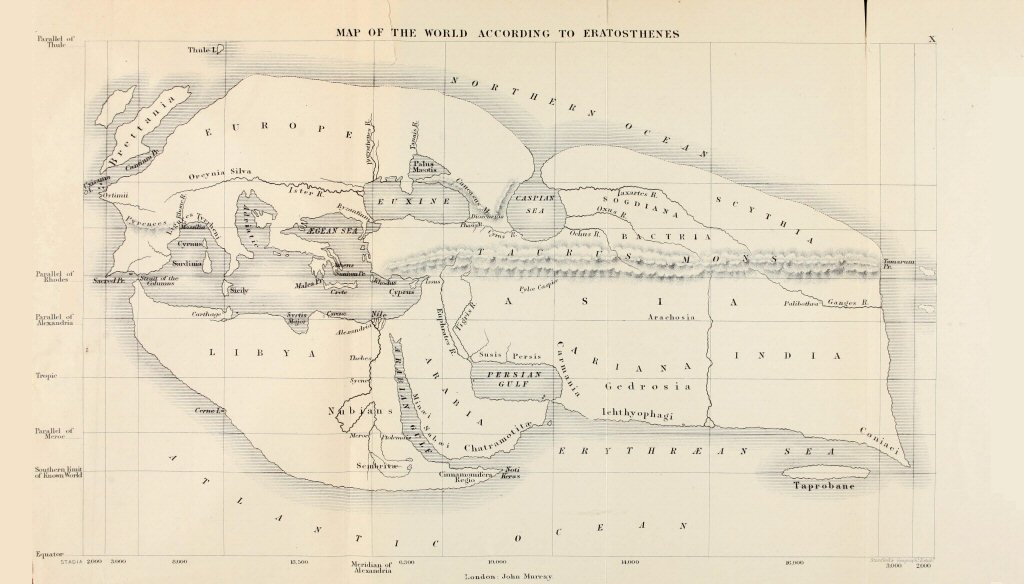
Paul’s use of these words and phrases eliminates the claim that, if a New Testament author uses the word kosmos, he’s referring to the whole world. And on top of that, while Jesus came to bring salvation to all people, the story of the Bible is centered on God’s covenant people and the world as they knew it. That world is somewhat depicted in the map above created by Eratosthenes roughly 200 years before Christ. During those two centuries, little had changed regarding the Roman Empire and the known inhabited land around the Mediterranean Sea.
While Paul tells us the gospel had gone out to “all the earth”, nevertheless, he was still planning on taking that message to Spain:
So that from Jerusalem and all the way around to Illyricum I have fulfilled the ministry of the gospel of Christ; and thus I make it my ambition to preach the gospel, not where Christ has already been named, lest I build on someone else’s foundation. . . . But now, since I no longer have any room for work in these regions, and since I have longed for many years to come to you, I hope to see you in passing as I go to Spain. (Romans 15:19–20, 23–24)
Paul wasn’t confused. He knew the known inhabited land didn’t represent all humanity and he understood that his ministry was to proclaim Jesus Christ to his world. The world that revolved around God’s covenant people.
In summary, when Jesus said the gospel would be proclaimed throughout the whole world before “the end,” we shouldn’t automatically read our modern concept of the entire globe into His words. Paul could say within the first century that the gospel had gone throughout the kosmos, to all nations, to the ends of the oikoumene, and even to “all creation under heaven.” The New Testament writers themselves therefore give us good reason to understand Jesus’ words within the geographical world known to His original audience.
The good news is that, today, our known inhabited land is truly the whole world. And through the kingdom that Jesus established in the first century, salvation can now spread across the entire planet.