
The author of Hebrews describes an interesting paradigm, “In speaking of a new covenant, he makes the first one obsolete. And what is becoming obsolete and growing old is ready to vanish away” (Hebrews 8:13).
Without a doubt, the new covenant made the old one obsolete, just as a new will and testament makes the previous one invalid. Yet the phrase, “becoming obsolete,” reveals that the inaugurated new covenant had not yet finished replacing the old. Legally, the old covenant had been surpassed. Historically, however, it was still standing. The temple still functioned. Sacrifices were still being offered. The transition was underway, but not yet complete. This is the tension felt throughout the New Testament.
Jesus said, “If it is by the Spirit of God that I cast out demons, then the kingdom of God has come upon you” (Matthew 12:28). Yet He taught His disciples to pray, “Thy kingdom come.” John wrote, “Now is the judgment of this world; now will the ruler of this world be cast out” (John 12:31). Yet Peter says, “Your adversary the devil prowls around like a roaring lion, seeking someone to devour.” And Paul expressed, “These things . . . were written down for our instruction, on whom the end of the ages has come” (1 Corinthians 10:11). Paul gave no indication that those ages had already passed, only that their end had come to his generation.
The transition from the old to the new was not like walking through a door. A door can’t take you from a room on the first floor to one on the third. They only work when both sides are on the same level. But rather than an improvement of the old, the new covenant would be something… well… new:
“Behold, the days are coming, declares the Lord, when I will make a new covenant with the house of Israel and the house of Judah, not like the covenant that I made with their fathers on the day when I took them by the hand to bring them out of the land of Egypt, my covenant that they broke, though I was their husband, declares the Lord.” (Jeremiah 31:31-32)
While the old covenant was based on animal sacrifices, the new was based on the blood of Jesus Christ. You can’t pour new wine into old wine skins. The new covenant was on a whole new level. It required a transition phase.
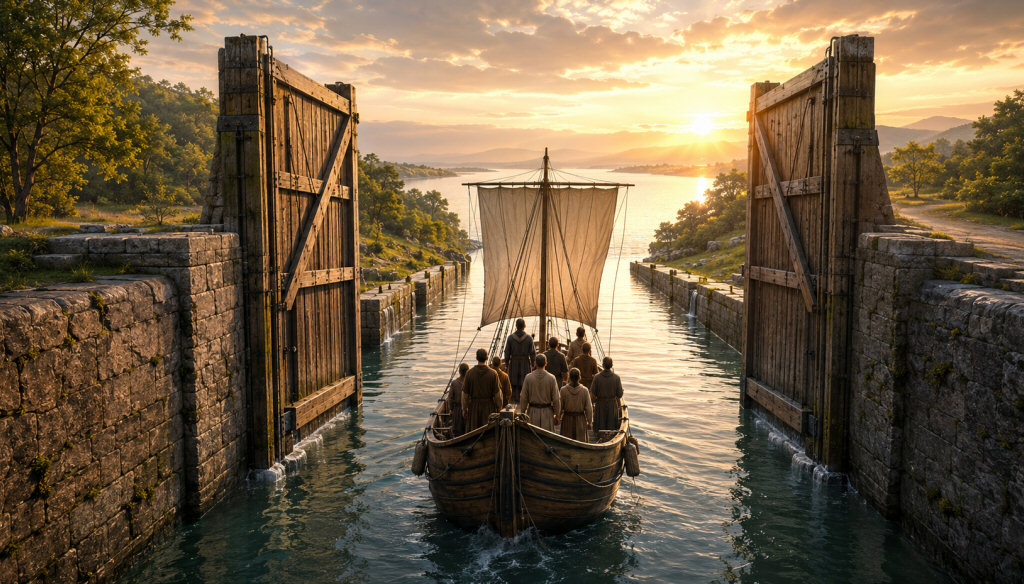
Picture a river lock. The ship carrying God’s faithful remnant floats into the lock. The death and resurrection of Jesus close the rear gate. Now the old covenant and Mosaic Law are behind them though many refuse to let go. For roughly forty years, the water rises. The gospel message spreads and many board the ship. Others are warned of the coming change. The new covenant kingdom is ready, but she can’t sail until the front gate is open. Finally, the destruction of the temple swept away the visible remains of the old covenant order and the front gate opened. The ship could now sail freely into the new covenant realm.
Hebrews was written inside the lock chamber which explains the language. In fact, there’s good reason to believe all the New Testament was written in that transitional time. A time of great tension as the old covenant was becoming obsolete and ready to vanish away.